
Acid reflux under control, but your gut feels off. Bloating, loose stools, or new sensitivities can creep in after starting a proton pump inhibitor. It is common to wonder if a spore-based probiotic can steady digestion, and whether 4 billion CFU has any real chance while stomach acid is being altered.
Spore-forming Bacillus probiotics are built to handle extremes. They do not need heavy enteric coatings or mega CFUs to reach the intestine. Still, PPI timing, dose, and the meal you pair them with can change results. Here is a clear, practical look at whether 4 billion CFU is reasonable during PPI use, plus how to use a product like MegaSporeBiotic more confidently.
How PPIs change the gut environment and why spores act differently
PPIs such as omeprazole 20 mg reduce acid secretion, raising gastric pH from near 1 to around 4 to 6 for parts of the day. This softens the stomach’s barrier function and alters transit. Some non-spore probiotics struggle in the stomach, so a higher pH can help survival. But the real question is what happens in the small intestine, where bile acids and oxygen levels guide whether microbes wake up or pass through.
Bacillus spores carry calcium dipicolinate in their core, a compound that gives heat and acid resilience. They stay dormant until they reach bile and nutrient signals in the small intestine. That means their survival does not depend on acid protection like lactobacilli do. PPIs do not switch off bile release. Bile is driven by fat in a meal, so pairing a spore probiotic with food that contains fat can cue germination where it matters most.
Another layer is the microbiome, the community of microbes in the gut. PPIs can shift this community toward more upper gut fermentation. That shift may increase gas. A spore probiotic may support balance by transiently occupying niches and producing enzymes or short-chain fatty acid precursors, but results vary and take time.
Is 4 billion CFU from a spore blend enough during PPI therapy?
For spore-based Bacillus blends, 4 billion CFU per day is generally adequate for survivability and practical effect during PPI use. Spores already resist acid and heat, so you do not need a 50 billion CFU buffer to offset stomach losses. Several Bacillus species, including Bacillus clausii and Bacillus coagulans, have been used at daily doses between 2 and 6 billion CFU in clinical contexts without relying on extreme CFU counts. CFU refers to colony forming units measured by plate count methods, not total DNA.
What matters is strain identity, how consistently you take it, and whether germination cues are present. If a capsule supplies 4 billion CFU of verified spores and is taken with a meal, survival through a PPI-adjusted stomach is usually not the limiter. Expect a subtle start. Changes in stool form, gas, or comfort may take 2 to 4 weeks. If the product is underdosed for you, the pattern is usually non-response rather than harm.
A limitation is that CFU alone does not predict function. A precise 4 billion CFU may still perform poorly if strains are mismatched to your needs or if you take it on an empty stomach without bile cues. On the flip side, pushing much higher CFUs can raise the risk of transient bloating or loose stools, especially if your baseline is already sensitive.
What matters beyond the CFU on the label: spores, strains, and excipients
MegaSporeBiotic and comparable blends typically include verified strains like Bacillus subtilis (for enzyme support), Bacillus clausii (acid resistant, historically used alongside antibiotics), Bacillus licheniformis, and specialty carotenoid producers such as Bacillus indicus HU36. HU36 makes orange-hued carotenoids that can be measured by HPLC, a chromatography method used to separate and quantify compounds. Identity confirmation often relies on 16S rRNA sequencing or strain-specific PCR to guard against mislabeling.
Excipients and delivery also matter. A simple cellulose capsule works for spores because they do not need elaborate enteric coatings. If a formula includes prebiotics like inulin or FOS, sensitive users may notice extra gas. That is not a failure of the spores, just a fermentable carbohydrate effect. Choose a blend that fits your tolerance rather than chasing a higher CFU count.
- Prefer strain-designated Bacillus (e.g., B. subtilis HU58) over generic species names.
- Avoid large amounts of inulin if high FODMAP foods already upset your gut.
- Check third-party testing where available. Plate count and qPCR both have roles.
Spore versus non-spore probiotics under PPI conditions: practical differences
| Feature | Spore-based Bacillus | Lacto/Bifido blends |
|---|---|---|
| Acid resilience | High due to calcium dipicolinate spores | Variable, often needs 10 to 50 billion CFU or enteric coating |
| Best timing | With a meal containing fat to trigger bile | Often with food or as directed by coating design |
| Common dose | 2 to 6 billion CFU daily | 10 to 100+ billion CFU daily |
| Main trade-off | Initial gas as spores germinate | More sensitive to heat and acid |
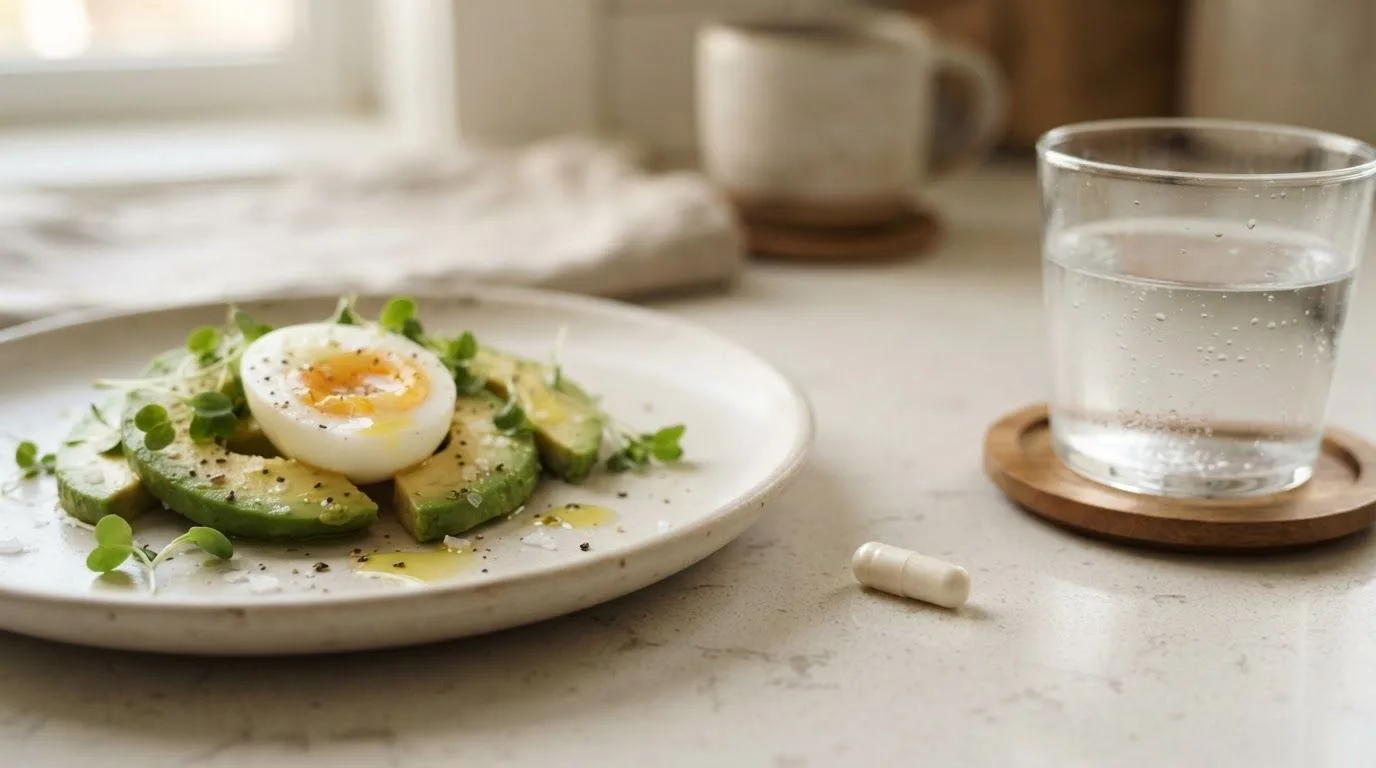
The non-obvious point here is timing with fat. A small amount of olive oil, eggs, avocado, or yogurt can raise bile flow and offer a stronger germination signal than the exact CFU number on the bottle.
Safety, interactions, and when to pause a spore probiotic during PPI use
Set expectations first. A spore probiotic may support comfort and regularity, but it does not cure reflux, eradicate overgrowth, or replace nutrition and sleep. Results are usually modest at 2 to 8 weeks. If you feel worse every day, the dose or the product is likely not a match right now.
- Interactions: Separate from antibiotics by at least 2 to 3 hours to reduce kill-off. Spore probiotics are generally used during antibiotics, but spacing helps.
- Contraindications: Avoid Bacillus probiotics if immunocompromised, on chemotherapy, or with a central venous catheter unless cleared by a clinician. Rare Bacillus bacteremia has been reported in high-risk settings.
- Sensitivities: If prone to diarrhea, start low. If prone to constipation, pair with hydration and steady fiber like partially hydrolyzed guar gum at 3 to 5 g per day.
- Red flags: Seek medical care for blood in stool, black tarry stool, persistent fever, unexplained weight loss, severe or nighttime abdominal pain, or dehydration signs.
An explicit limitation is that PPIs themselves can shift the microbiome toward more small intestinal fermentation. A probiotic will not fully counter that if the PPI is still needed. Discuss step-down strategies with a clinician, not with supplements alone.
FAQ on PPI use and spore-based probiotic dosing
Do PPIs destroy probiotics like MegaSporeBiotic?
No. Spores are built to tolerate acid and heat, so PPI use does not prevent them from reaching the intestine. Non-spore probiotics are more sensitive to acid, but even they may survive better when gastric pH is higher. The key for spores is taking them with food so bile signals germination.
Should you take a spore probiotic with omeprazole in the morning or with food?
Take the probiotic with a meal that contains some fat, regardless of when the PPI is taken. A lunch or dinner dose often works well. If you take omeprazole 30 minutes before breakfast, you can take the spore probiotic with breakfast itself.
How long should you try a spore probiotic on a PPI before judging results?
Give it 3 to 4 weeks at a steady dose, then reassess. A fair trial looks like 1 capsule daily for 5 to 7 days, then 2 capsules daily for at least 14 days. Track stool form with the Bristol Stool Scale and note gas or urgency patterns.
Are non-spore probiotics pointless on PPIs?
No. Some lactobacilli and bifidobacteria still help, especially if properly coated or dosed at 20 to 50 billion CFU. They are simply more sensitive to heat and acid. A practical approach is to trial one category at a time to read your response.
Practical dosing and timing for MegaSporeBiotic during PPI use
Start with 1 capsule that provides about 2 billion CFU daily for 5 to 7 days, taken with a meal that includes fat to prompt bile release. If tolerated, increase to 2 capsules daily for a total of 4 billion CFU. This dose is typically sufficient for spore blends even on a PPI, because survival is driven by the spore coat and bile-triggered germination, not by overpowering the stomach with massive CFUs. If you experience cramping or urgent loose stools lasting more than 72 hours after an increase, drop back to the lower dose or pause and retry in one week.
Consistency beats chasing the perfect clock. Lunch or dinner is fine. Hydration helps motility - sipping 300 to 500 mL water between meals, not all at once, can reduce stool swings more than the exact capsule minute. If your goal is steadier stools, aim for Bristol type 3 to 4 and adjust fiber gently. Reassess after 6 to 8 weeks. If no meaningful change is seen, switch strains or consider complementary steps like a short low FODMAP phase, or adding a well-tolerated prebiotic such as partially hydrolyzed guar gum at 3 g daily, ideally introduced after the probiotic routine feels stable.